
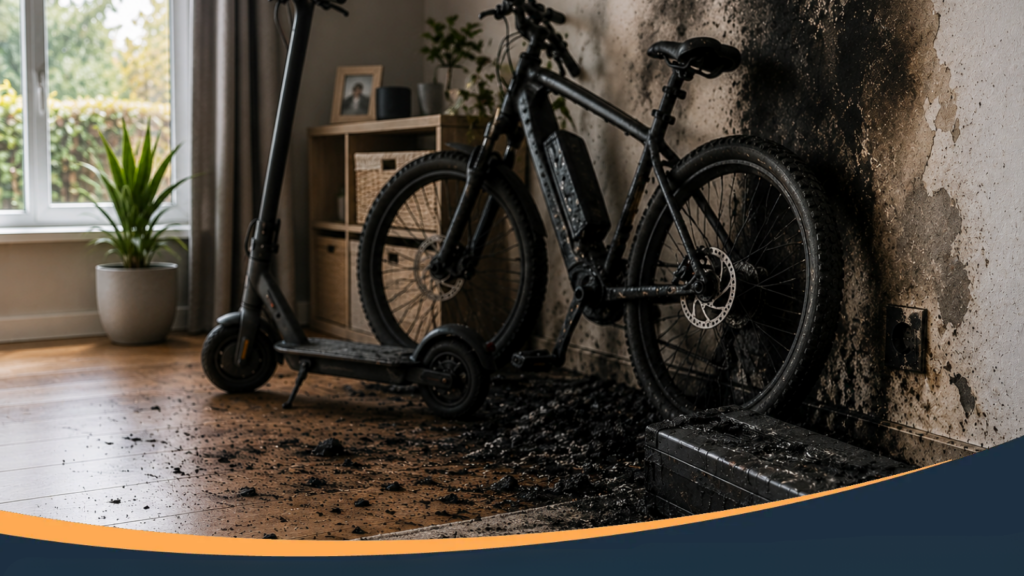
E-bike and e-scooter battery fires are a known fire risk in homes and apartment buildings, particularly where a battery is charged in a hallway or stairwell.
Less attention is usually paid to what happens after the fire is out: the insurance claim.
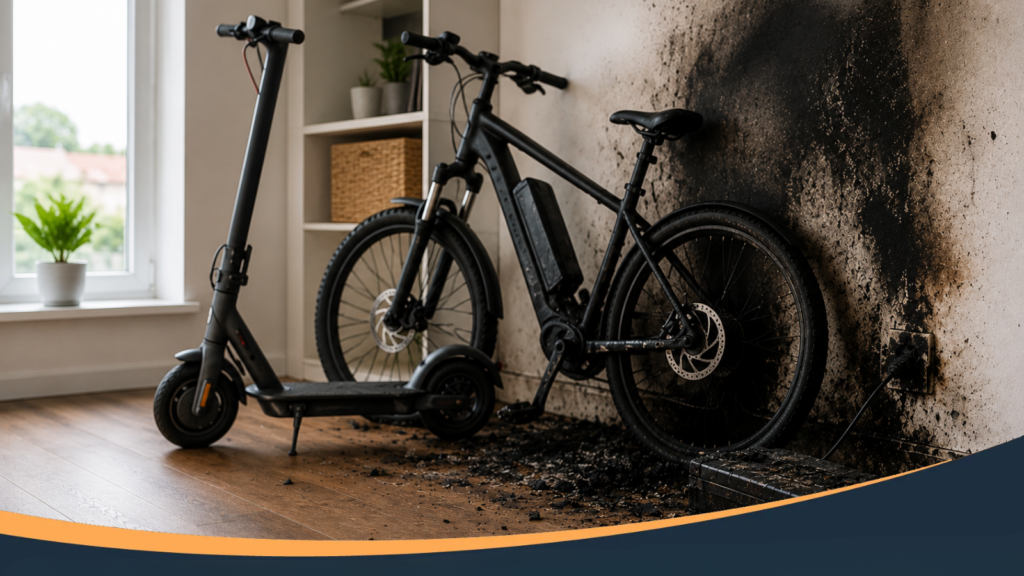
If a lithium-ion battery in your hallway or your home has caused a fire, your first call is to the fire brigade, and your second call is to your insurer. Insurers may ask more questions about the cause of a battery fire than for some other claims, so it helps to set the claim up properly from the start.
What Actually Causes These Fires
Lithium-ion batteries fail through a process called thermal runaway. Once a cell inside the battery overheats past a certain point, it can’t cool itself down. The reaction feeds itself, the temperature climbs fast, and the result is a fire that burns hotter and faster than almost anything else you’ll encounter in a domestic setting. Triggers can include chargers that don’t match the bike, batteries that have been damaged in a fall or a knock, water damage, and batteries left charging for far longer than they need to be.
Where a fire starts also matters for insurance purposes. A fire that starts in a communal area of an apartment block, such as a stairwell or shared hallway, can raise different questions for an insurer than one that starts inside your own front door.
Will Your Home Insurance Actually Cover It?
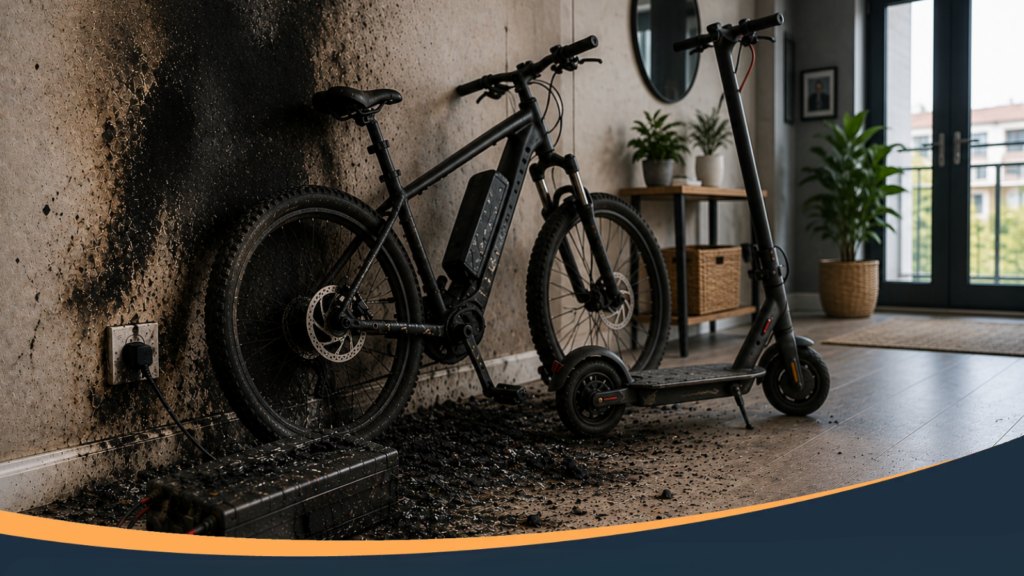
It may do, depending on your policy and its conditions. Fire damage to the structure of your home, whether the fire started from your own e-bike battery or someone else’s, is typically covered under your building’s policy. Damage to your contents, the bike itself, your furniture, and your belongings sits under a separate section of cover, and that’s where the detail in your policy wording starts to matter.
Insurers don’t treat every battery fire claim the same way. If the fire is judged to have resulted from an unapproved charger, a modified or de-restricted e-bike, or a battery that was clearly damaged and still in use, an insurer may question whether a policy condition or exclusion applies. How the cause of the fire is established can make a real difference to how the insurer views the claim.
Why Insurers Look More Closely at Battery Fire Claims
There are three main reasons for the closer look.
First, the cause of ignition is rarely obvious to the naked eye. A battery casing that’s melted in a fire looks much the same whether the original fault was a manufacturing defect, physical damage from a fall six months earlier, or an incompatible charger. Proving which one it was requires proper investigation, so it is worth having the cause examined and recorded before any conclusions are drawn.
Second, the insurer may ask where the device and battery were bought and whether they were approved for use.
Third, communal storage and charging arrangements in apartment blocks sit in a genuine grey area. Whose policy responds when a fire starts in a shared stairwell that serves twenty units? The building’s block policy, the individual apartment owner’s or tenant’s contents policy, or both, depending on where the damage lands. Getting that question wrong at the outset is a common cause of delay.
None of this means your claim will fail. It means the claim needs to be well documented from the start, because it is generally up to the policyholder to show what was lost and how it happened.
What to Do in the First 48 Hours
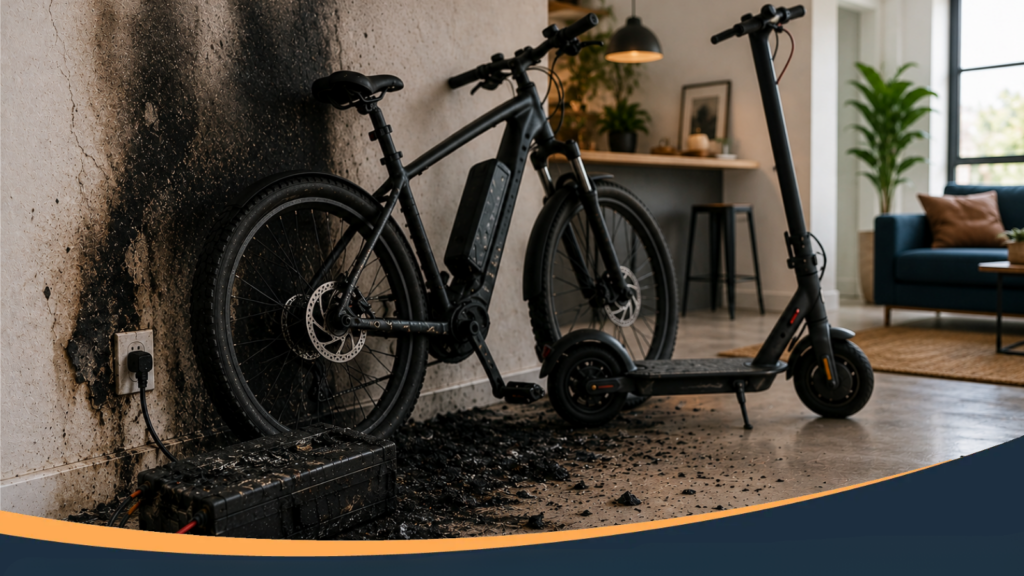
The steps you take immediately after the fire can affect how the claim is assessed.
Don’t discard the battery, the charger, or any damaged components, even if the fire brigade has cleared the scene and it’s safe to tidy up. That equipment is the physical evidence that determines cause, and once it’s gone, it can be hard to establish the cause. Photograph everything before anything is moved, including the charging setup as it was at the time. If you have proof of purchase for the bike, the battery, or the charger, find it now rather than searching for it in three weeks when the insurer asks. And notify your insurer promptly and in writing, describing what happened factually without speculating about cause, since that’s an assessment that should come from an investigation, not from you guessing under stress.
How a Loss Assessor Can Help With a Battery Fire Claim
A fire claim in which the cause, the origin of the product and the applicable policy are all in question can be more involved than a standard fire claim, and a loss assessor can help you to prepare and present it.
Trevor Kelly is a Chartered Building Surveyor (MSCSI, MRICS) and a public loss assessor, and he has handled property insurance claims since 2009. A surveyor can record the physical extent of the damage in technical detail, and a loss assessor deals with the insurer and its loss adjuster on your behalf.
Notify your insurer promptly and cooperate with its enquiries. You can also contact us at the same time.
Frequently Asked Questions
Does home insurance cover e-bike or e-scooter battery fires in Ireland?
It may be, under your buildings and contents cover, but insurers may query claims where the fire is linked to an unapproved charger, a modified device, or a battery that was visibly damaged before the fire. The specifics of your policy wording decide where the line falls.
Is e-bike or e-scooter insurance a legal requirement in Ireland?
Whether a separate insurance requirement applies depends on the type of vehicle, as e-bikes and e-scooters are treated differently under Irish road traffic rules, so check the current rules on gov.ie. Home insurance covering the bike as a possession and covering any fire damage it causes is a separate question entirely from whether the bike itself needs to be insured.
Can an insurer refuse a claim for an e-bike battery fire?
An insurer may decline a claim where a policy condition or exclusion applies, for example where an unapproved charger or a modified battery system is involved. If you disagree with a decision, ask the insurer to explain it, and you can complain to the insurer and then, once you have its final response, to the Financial Services and Pensions Ombudsman.
What happens if the fire started in a shared area of an apartment block?
This depends on the specific arrangement between the building’s block policy and individual apartment owners’ policies, and it is often one of the harder questions in these claims. Getting an early, independent read on which policy responds can help avoid delay.
Can I get an independent assessment of the damage?
Yes. Notify your insurer promptly and cooperate with its enquiries. You can also contact a loss assessor at the same time to record the damage and the cause.
Trevor Kelly Insurance Claim Solutions Limited, trading as Insurance Claim Solutions, is regulated by the Central Bank of Ireland (Reg. No. C423441). We explain our fee and agree it with you in writing before we start any work. If you are unhappy with our service, you can complain to us and, if needed, to the Financial Services and Pensions Ombudsman (fspo.ie). You can check our registration on the Central Bank of Ireland register.