
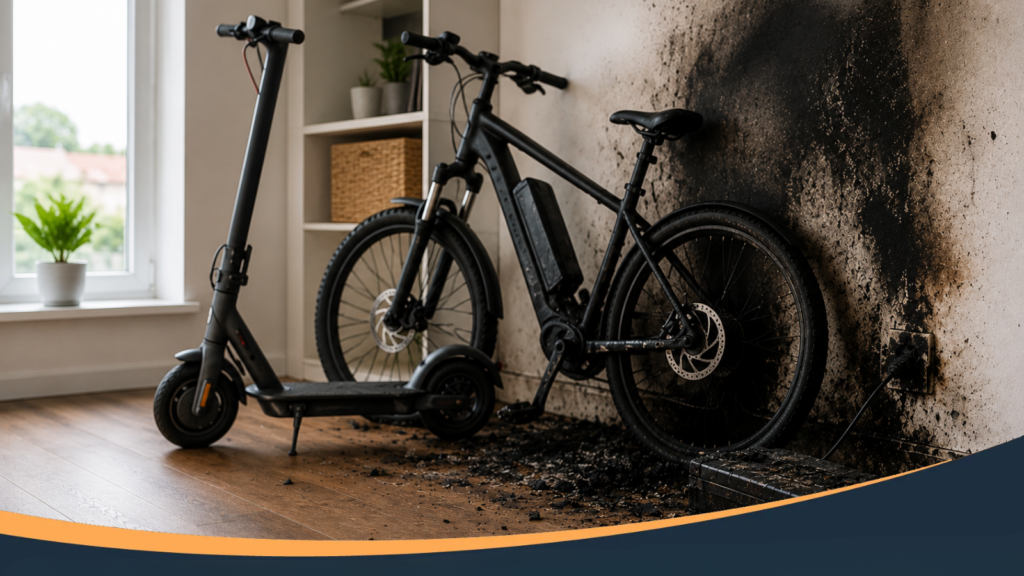
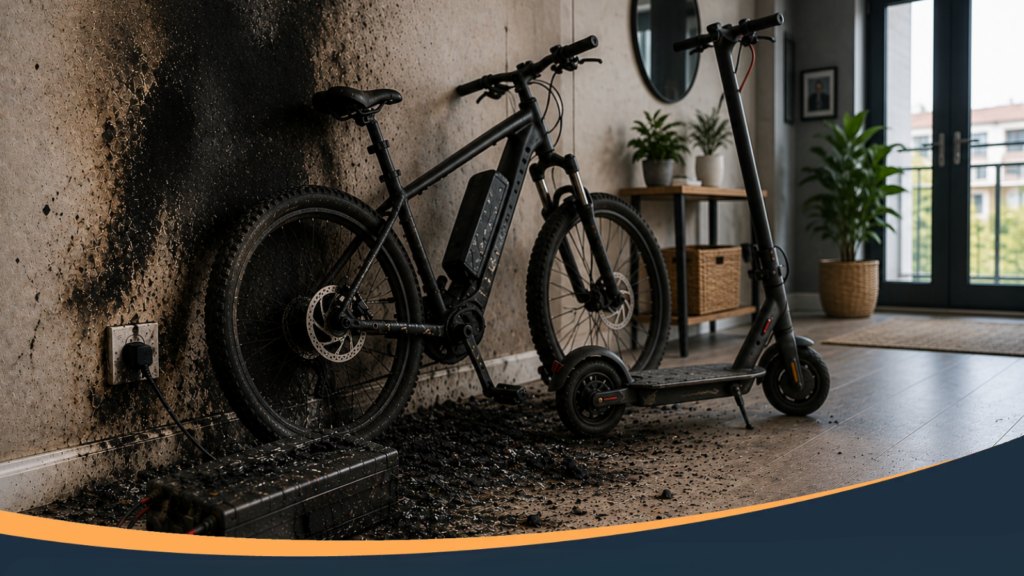
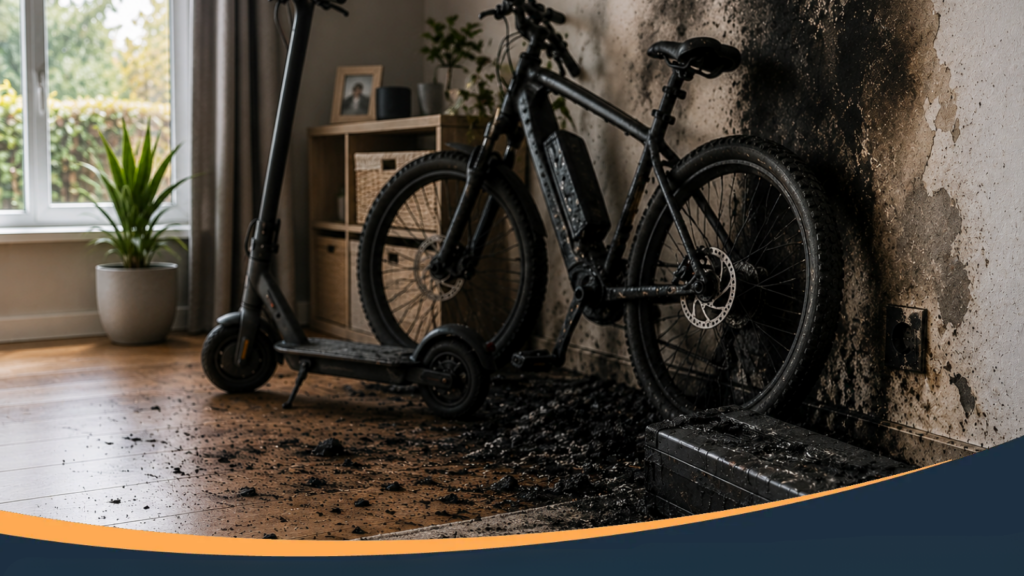
Dublin Fire Brigade has been warning about it for two years. E-bike and e-scooter battery fires are no longer a rare event in this city; they’re a pattern, and the pattern keeps showing up in the same places: apartment stairwells, communal hallways, and the spot beside the front door where the battery sits on charge overnight because there’s nowhere else to put it.
What almost nobody is talking about is what happens next. Not the fire itself, but the claim.
If a lithium-ion battery in your hallway or your home has caused a fire, your first call is to the fire brigade, and your second call is to your insurer. But the insurer’s first instinct on a claim like this isn’t the same as it is for a burst pipe or a kitchen fire. These claims get looked at differently, and if you don’t understand why, you can end up settling for a lot less than you’re entitled to or having the claim knocked back altogether.
What Actually Causes These Fires
Lithium-ion batteries fail through a process called thermal runaway. Once a cell inside the battery overheats past a certain point, it can’t cool itself down. The reaction feeds itself, the temperature climbs fast, and the result is a fire that burns hotter and faster than almost anything else you’ll encounter in a domestic setting. Dublin Fire Brigade has pointed to specific triggers: chargers that don’t match the bike, batteries that have been damaged in a fall or a knock, water damage, and batteries left charging for far longer than they need to be.
The other pattern the brigade has flagged, and one that matters enormously for insurance purposes, is where these fires start. A growing number of incidents in Dublin have happened in communal areas of apartment blocks, stairwells and shared hallways where residents store and charge bikes because there’s no safe alternative. One recent incident saw nine people evacuated from a building in the Liberties after a battery that wasn’t even on charge ignited in a stairwell.
That detail matters. A fire that starts in a shared space, from a device that wasn’t actively charging, raises different questions for an insurer than one that starts inside your own front door.
Will Your Home Insurance Actually Cover It?
In most cases, yes, but with conditions that catch people out. Fire damage to the structure of your home, whether the fire started from your own e-bike battery or someone else’s, is typically covered under your building’s policy. Damage to your contents, the bike itself, your furniture, and your belongings sits under a separate section of cover, and that’s where the detail in your policy wording starts to matter.
Here’s the part most guides skip entirely. Insurers don’t treat every battery fire claim the same way. If the fire is judged to have resulted from an unapproved charger, a modified or de-restricted e-bike, or a battery that was clearly damaged and still in use, an insurer can argue the loss was foreseeable, and foreseeable losses are exactly the kind of thing policies are written to exclude. You haven’t done anything fraudulent. You’ve just charged a bike the way thousands of people in Dublin charge a bike every night. But “foreseeable” and “negligent” are words an insurer’s assessor gets to interpret first, and they’re rarely interpreting them in your favour.
This is where the gap between what Dublin Fire Brigade tells you to prevent a fire and what your insurer needs to pay out on one becomes obvious. The brigade’s advice exists to keep you safe. It was never designed to protect your claim.
Why Insurers Scrutinize These Claims Harder Than a Standard Fire
Three things drive that extra scrutiny, and it’s worth knowing all three before you’re the one making the call.
First, the cause of ignition is rarely obvious to the naked eye. A battery casing that’s melted in a fire looks much the same whether the original fault was a manufacturing defect, physical damage from a fall six months earlier, or an incompatible charger. Proving which one it was requires proper investigation, and if you don’t commission that investigation yourself, the insurer’s assessor will draw the conclusion that suits them.
Second, the market for e-bikes and e-scooters in Ireland is still largely unregulated at the point of sale. Cheaper imported batteries, often bought online with little traceability, have been directly linked to a disproportionate share of fires. If your device or battery came from a less established retailer, expect the insurer to ask about it, and expect that question to shape how they view the rest of your claim.
Third, and this is the one people don’t see coming, communal storage and charging arrangements in apartment blocks sit in a genuine grey area. Whose policy responds when a fire starts in a shared stairwell that serves twenty units? The building’s block policy, the individual leaseholder’s contents policy, or both, depending on where the damage lands. Getting that wrong, or letting the insurer decide it for you, is how claims get delayed for months or paid out at a fraction of what they should be.
None of this means your claim is doomed. It means the insurer’s opening position is built to protect their numbers, not yours, and the burden of proving otherwise sits with you.
What to Do in the First 48 Hours
The steps you take immediately after the fire are the ones that decide whether this becomes a straightforward claim or a drawn-out argument.
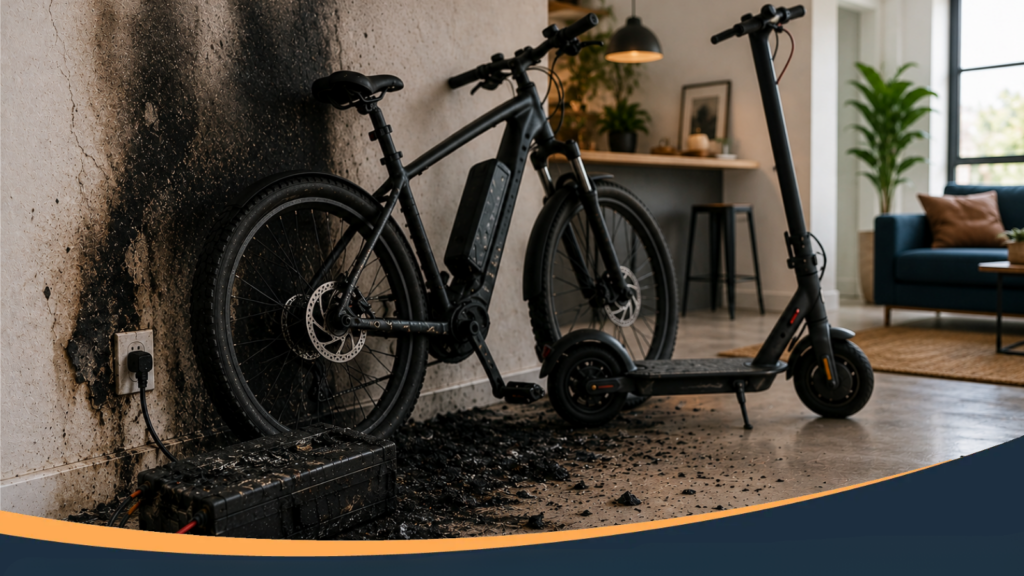
Don’t discard the battery, the charger, or any damaged components, even if the fire brigade has cleared the scene and it’s safe to tidy up. That equipment is the physical evidence that determines cause, and once it’s gone, you’ve lost your strongest tool for proving the fire wasn’t your fault. Photograph everything before anything is moved, including the charging setup as it was at the time. If you have proof of purchase for the bike, the battery, or the charger, find it now rather than searching for it in three weeks when the insurer asks. And notify your insurer promptly and in writing, describing what happened factually without speculating about cause, since that’s an assessment that should come from an investigation, not from you guessing under stress.
Why This Is Exactly the Kind of Claim a Loss Assessor Exists For
A standard fire claim is complicated enough. One where the insurer has grounds to question negligence, product provenance, and which policy even applies is a different category of complicated, and it’s precisely where having someone independently qualified on your side changes the outcome.
Trevor Kelly brings a combination that’s genuinely rare in this market: fifteen years handling property insurance claims as a Central Bank of Ireland-regulated public loss assessor, alongside formal qualifications as a building surveyor accredited by the Society of Chartered Surveyors Ireland. On a battery fire claim, that dual expertise matters in a very practical way. A surveyor’s eye can establish and document the physical cause and extent of damage with the kind of technical credibility an insurer’s own assessor can’t easily dismiss. A loss assessor’s experience means the negotiation that follows is handled by someone who has been on this side of the table before, not someone doing it for the first time under pressure.
This isn’t about being adversarial with your insurer, or with the loss adjuster they send out to assess the damage. It’s about making sure the person representing your interests in that room has the same level of expertise the insurer’s side does. Right now, in most of these cases, that’s not what happens. The insurer sends an expert. The homeowner sends them.
Frequently Asked Questions
u003cstrongu003eDoes home insurance cover e-bike or e-scooter battery fires in Ireland?u003c/strongu003e
Generally yes, under your buildings and contents cover, but insurers may dispute claims where the fire is linked to an unapproved charger, a modified device, or a battery that was visibly damaged before the fire. The specifics of your policy wording decide where the line falls.
u003cstrongu003eIs e-bike or e-scooter insurance a legal requirement in Ireland?u003c/strongu003e
Standard e-bikes under 250 watts and capped at 25km/h don’t legally require separate insurance in Ireland. That said, home insurance covering the bike as a possession and covering any fire damage it causes is a separate question entirely from whether the bike itself needs to be insured.
u003cstrongu003eCan an insurer refuse a claim for an e-bike battery fireu003c/strongu003e?
Yes, and it happens more often on these claims than on a standard fire loss. The most common grounds are negligence, an unauthorised charger, or a modified battery system. That doesn’t mean the refusal is correct, only that the burden falls on you to challenge it with proper evidence.
u003cstrongu003eCan an insurer refuse a claim for an e-bike battery fire?u003c/strongu003e
This depends on the specific arrangement between the building’s block policy and individual leaseholder policies, and it’s one of the most contested grey areas in these claims. Getting an early, independent read on which policy responds can prevent months of delay.
u003cstrongu003eWhat happens if the fire started in a shared area of an apartment block?u003c/strongu003e
This depends on the specific arrangement between the building’s block policy and individual leaseholder policies, and it’s one of the most contested grey areas in these claims. Getting an early, independent read on which policy responds can prevent months of delay.
u003cstrongu003eShould I get an independent assessment before speaking to my insurer’s loss adjusteru003c/strongu003e
It’s worth doing before you agree to anything, and certainly before you accept an initial settlement figure. An independent assessment establishes your own documented position on cause and value before the insurer’s version becomes the only one on record.
Insurance Claim Solutions is regulated by the Central Bank of Ireland as a Public Loss Assessor, Reg. No. C423441. Trevor Kelly operates on a no-win, no-fee basis, with fees charged at [FEE_PERCENTAGE] of the agreed settlement, disclosed in full before any work begins. If you’re unhappy with the service provided, you can escalate your complaint to the Financial Services and Pensions Ombudsman at FSPO. ie. You can verify our regulated status on the Central Bank of Ireland’s register at registers.ie. central bank. ie.