

After a house fire, it can be difficult to know what to do next. Once the emergency services have left and the immediate danger has passed, homeowners are often left facing practical questions about safety, temporary accommodation, repairs, contents, policy cover and the claims process itself.
The decisions made in the early stages can have a significant impact on how clearly the claim is documented and progressed. Evidence may need to be recorded before cleaning, clearance or repair works begin, and the full extent of fire, smoke and water damage may not be immediately visible.
When a claim is notified, the insurer may appoint a loss adjuster to assess the damage and report on the claim. A public loss assessor has a different role. They are appointed by the policyholder to help prepare, document and present the claim and to support the policyholder throughout the process.
This article explains how home insurance generally responds to fire damage in Ireland, what may be covered under a standard home insurance policy, common exclusions and limitations, and why early documentation can make a significant difference to how a claim is assessed.
It also looks at the factors that can affect the value of a fire claim, including structural damage, smoke contamination, water damage from firefighting, contents loss, alternative accommodation and any policy conditions that may apply.

What Does Home Insurance Cover for Fire Damage in Ireland?
In Ireland, fire is commonly included as a standard insured peril under Irish home insurance policies, subject to policy terms, limits and exclusions. There is no standalone “fire insurance” product. Fire is one of the named perils your buildings and contents cover protects you against, alongside flood, storm, escape of water, subsidence, and theft.
When a fire damages your property, a standard home insurance policy may cover the following.
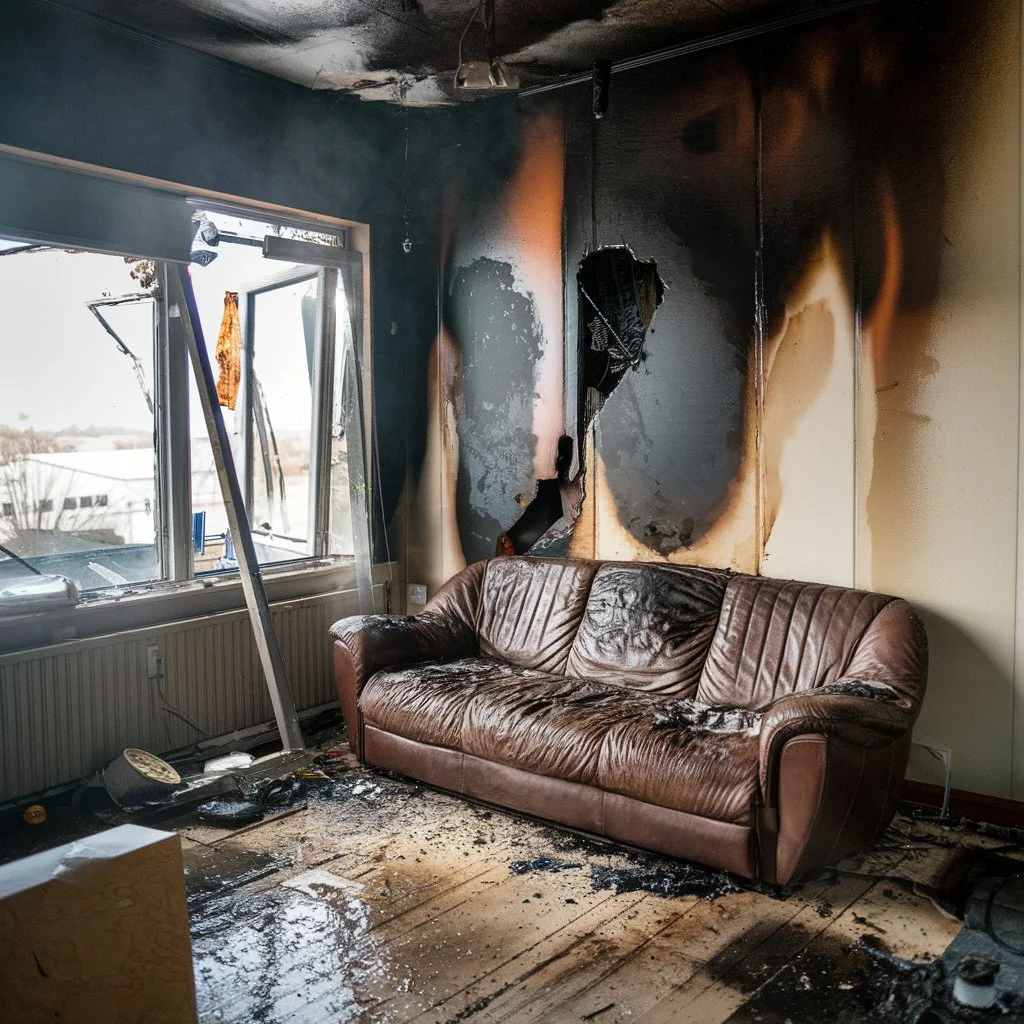
| Structural damage to the building. Building insurance covers the structure of your home: walls, roof, ceilings, floors, foundations, and permanent fixtures such as fitted kitchens, wardrobes, plumbing, electrical wiring, and fixed lighting. If a fire starts in your kitchen and spreads to the ceiling and roof cavity, building cover steps in to fund structural repair and full reinstatement. | Damage to contents. Contents insurance covers furniture, clothing, electronics, appliances, and household items damaged or destroyed by fire, up to your policy’s stated limit. High-value items, jewellery, art, specialist equipment, may require separate scheduling within your policy. If you have not recently reviewed your contents sum insured, it is worth doing before a loss occurs rather than after. | Smoke and soot damage. Many homeowners don’t expect this one. Many claims are under-settled here too. A fire contained to one room can contaminate an entire house. Smoke travels through ventilation systems, soaks into walls and soft furnishings, and embeds itself in textiles, flooring, and wall cavities where it is invisible to the eye but demonstrable to a specialist. Smoke remediation often costs more than the fire damage itself. Your policy covers this, but only when it is fully documented and properly claimed. |
| Water damage from firefighting. The water pushed through a property during suppression regularly causes serious damage to floors, ceilings, plasterwork, and subfloors that rivals the fire damage itself. This is claimable under a standard buildings and contents policy, and it may be overlooked if the full extent of water damage is not investigated and documented. | Emergency services charges. Most home insurance policies in Ireland also cover fire brigade call-out fees up to a specified limit, typically around €2,000. | Alternative accommodation. If your home becomes uninhabitable following a fire, your home insurance will typically cover the cost of temporary accommodation while repairs are carried out. On a substantial claim, this can run for months, and those costs accumulate. |
What Home Insurance Does Not Cover for Fire Damage
The claim Every insurance policy has exclusions. Knowing them in advance protects you from avoidable disputes at the claim stage.
Negligence and poor maintenance. If faulty wiring that had been identified and left unrepaired causes a fire, or if a blocked, uncleaned chimney leads to a chimney fire, the company may argue that the damage caused arose from negligence rather than a sudden, unforeseen event. This is one of the most contested areas in fire claim disputes.
Accidental damage? Check your policy. Standard policies in Ireland do not automatically include accidental damage cover for all scenarios. Accidental damage caused by fire, in a straightforward sense, a candle left unattended, or a chip pan typically falls within the standard perils covered. But damage to the wider fabric of the property caused by an accident can be a grey area depending on how cover is defined in your policy documents. If you are unsure what is included, check your policy documents before a loss rather than during one.
Deliberate acts by the policyholder. Arson by the homeowner, or by anyone acting with their knowledge, voids a claim. The cause of the fire is investigated as a standard part of the claims process on all significant losses.
Unoccupied properties. Most home insurance policies carry an unoccupied property clause. If your home is left vacant beyond a specified period, commonly 30 to 60 days, cover may be reduced or invalidated. This affects landlords as well as owner-occupiers. If you are a landlord with a property between tenancies, or an owner-occupier travelling for an extended period, check your policy carefully.
Wear, tear, and gradual deterioration. Fire damage arising from a condition that built over time rather than occurring suddenly sits in disputed territory. The cause will be examined carefully. This is one reason independent professional representation matters from the earliest stage of a claim. Having a qualified building surveyor who understands both the technical and insurance dimensions of cause and origin puts you in a stronger position.
Properties under renovation. Standard policies may carry restrictions on cover while significant structural work is in progress. If renovation work is under way when fire damage occurs, check whether your cover is still fully operative.
How Much Is a Fire Claim Worth in Ireland?

The value of a fire claim depends on the policy wording, sums insured, extent of damage and evidence available. No two claims are the same, but costs can increase significantly once fire damage, smoke contamination, water damage from firefighting, structural issues, content loss and alternative accommodation are considered together.
A fire that appears limited at first can sometimes involve wider damage once the property is properly assessed. The following ranges are broad examples based on claims experience and should not be treated as an estimate of any individual claim.
Kitchen fire, contained: €25,000 to €200,000+. A kitchen fire appears localised. Smoke contaminates the entire ground floor, sometimes the full house. Water used in suppression damages floors and adjacent rooms. A full kitchen replacement, redecoration, floor restoration, specialist smoke cleaning throughout the property, and temporary accommodation while work is completed add up quickly.
Single room fire: €30,000 to €200,000+. Once a fire spreads beyond a single appliance and damages wall and ceiling structures, the claim escalates. Structural reinstatement, specialist remediation of affected areas, smoke clearance through the property, and contents replacement are all in scope.
Major house fire: €150,000 to €500,000 or more. A fire that spreads through roof cavities, damages multiple floors, or requires partial or full structural rebuilds is a complex, multi-month claim. Temporary accommodation costs alone can run to several thousand euro per month.
Total loss: €250,000 to €1,000,000 or more. These are complete rebuilds. They require full architectural and structural specification, planning involvement in some cases, full contents scheduling, and ongoing claim management over 12 to 24 months.
The insurer’s assessment may not always capture the full scope of damage at the outset, particularly on complex fire losses where smoke, water damage, contents and reinstatement costs require detailed evidence. Independent representation can help ensure the claim is properly documented, presented and supported.
ICS operates on a no win, no-fee basis. Our fee is a percentage of the final settlement. There is no upfront cost, and nothing to pay unless your claim is settled.
Why Independent Support Can Help in a Fire Insurance Claim
When you notify your insurer of a fire, they will appoint a loss adjuster to assess the damage and report on the claim. A loss adjuster is appointed by the insurer and plays an important role in reviewing the circumstances of the loss, the extent of the damage and the policy position.
A public loss assessor has a different role. They are appointed by the policyholder to help prepare, document and present the claim and to support the policyholder throughout the process.
For most homeowners, a fire claim is unfamiliar territory. Alongside the practical disruption of being displaced from the property, there may be structural issues, smoke contamination, water damage from firefighting, contents inventories, temporary accommodation costs and ongoing correspondence with the insurer.
Insurance Claim Solutions assists policyholders by carrying out an independent assessment of the damage, preparing a detailed schedule of loss, reviewing the relevant policy terms and managing communication with the insurer and their appointed representatives. Where required, we also coordinate input from appropriate specialists so that the full extent of the loss is properly documented and presented.
The aim is to make sure the claim is progressed clearly, accurately and with the right supporting evidence from the outset.
Under-Insurance: The Risk That Multiplies Every Fire Claim
Before the claim process, there is a risk worth naming that affects a significant proportion of Irish homeowners: under-insurance.
building’s To insure your home correctly, your building’s sum insured must reflect the current rebuild cost of the property. Not its market value, not what you paid for it, and not what you estimated five years ago. Rebuild costs include demolition, materials, labour, professional fees, and VAT at current construction rates. In Ireland, construction costs have risen sharply in recent years. Many homeowners who have not updated their sum insured are materially under-insured without knowing it.
The claim-building insurance that falls short of the actual rebuild cost can trigger the average clause at claim stage. Under this clause, the settlement is reduced in proportion to the shortfall. A homeowner with a rebuild cost of €400,000 who carries buildings cover of €280,000 is not simply exposed for the €120,000 gap. A proportionate reduction is applied across the entire claim. This is one of the most financially damaging outcomes a claimant faces, and it is entirely preventable.
Get it wrong, and the day you need your policy most is the day it pays you the least.
What to Do Immediately After a Fire in Ireland
The first 48 hours shape everything that follows. Here is what to prioritise.
Confirm the property is safe before re-entering. Fire damage can compromise structural integrity in ways that are not visible from outside. Wait for confirmation from the emergency services or a structural professional before going back in.
Document all damage before anything is disturbed. Photograph and video every room, every damaged item, every affected surface. Capture smoke migration, water damage, and structural damage alongside the fire-affected areas. Do this before anything is removed, cleaned, or covered. This documentation is the evidentiary foundation of your claim.
Contact Insurance Claim Solutions as early as possible. The earlier we are involved, the stronger your claim. Call us on 01 870 9210 or 086 053 9137. We will tell you exactly where you stand, at no cost and no obligation.
Notify your insurer promptly. You are contractually required to report a claim without undue delay. Contact your insurer or broker as soon as it is practical to do so. Notification is not the same as accepting the first assessment put to you. You retain the right to independent professional representation at every stage.
Be careful about authorising early works. Emergency contractors are sometimes arranged quickly by the insurance provider for site security or emergency clearance. Securing the property is entirely reasonable. Be cautious about authorising any work that removes or destroys evidence of damage before it has been fully and independently assessed.
How ICS Manages Your Claim, So You Don’t Have To
When you appoint ICS, the first thing that changes is this: you stop dealing with the insurance company directly. We take over from day one.
The process starts with a full independent site inspection. Trevor Kelly, as a chartered surveyor and registered public loss assessor, personally leads the technical assessment on complex losses. This covers structural damage, smoke migration, water ingress from firefighting, and the full contents loss. An independent schedule of loss is produced that reflects the complete claim, not just what is immediately visible or what appears in the initial survey.
Your insurance policy is reviewed in detail, covering limits, conditions, exclusions, under-insurance exposure, and applicable endorsements, so you understand your exact position before negotiations begin.
From there, all correspondence with the insurer and their appointed loss adjuster is handled by ICS. You do not deal with the insurance provider directly unless you choose to. We attend all surveys, inspections, and meetings on your behalf, and everything required is in place to progress the claim accurately and without delay.
Then comes the negotiation. A claim left to run on its own and a professionally represented one diverge most sharply here. Where loss or damage has been undervalued, we present independent evidence, bring in specialist assessors where needed, and pursue the full entitlement.
Once a settlement is agreed, we remain involved through the repair process to make sure the work meets the standard required under the claim.
Throughout, you have direct access to your assessor and regular updates on where things stand.
How Long Does a Fire Claim Take in Ireland?
There is no fixed timeline. Duration depends on the scale of the damage, the complexity of the claim, how quickly liability is accepted, and whether there are any disputed elements.
A straightforward kitchen fire claim with no liability dispute can move from assessment to settlement in eight to sixteen weeks. A major structural fire typically takes six to twelve months, sometimes longer where planning involvement or complex structural specification is required.
The fastest path through a fire claim is a complete, well-documented claim presented on day one. That is exactly what we do.
Frequently Asked Questions: Home Insurance and Fire Damage in Ireland
public loss assessor Does home insurance cover fire damage in Ireland?
Yes. Fire damage is a named peril under all standard home insurance policies in Ireland. Both building insurance and contents insurance apply, subject to the terms and exclusions of your specific policy.
What does home insurance not cover for fire damage?
Common exclusions include damage arising from negligence or poor maintenance, deliberate acts by the policyholder, fires occurring while the property is unoccupied beyond the permitted period, accidental damage where that extension has not been added to the policy, and deterioration that is gradual rather than sudden. Policy wording varies between providers. Always review your own documents.
Does home insurance cover smoke damage in Ireland?
Yes, though smoke damage is an area where the full extent of damage can be difficult to identify without specialist assessment.
How much can I claim for a fire in Ireland?
Claim values depend on the scale of the fire and the full extent of loss or damage. Kitchen fires typically produce claims in the range of €25,000 to €200,000+. Single room fires often run from €30,000 to €200,000. Major fires and total losses range from €150,000 to €500,000 or more. These figures reflect the full claim scope, structural damage, smoke, water, contents, and temporary accommodation, not the fire damage alone.
What is the difference between a loss assessor and a loss adjuster?
A loss adjuster is appointed and paid by your insurer to assess your claim on the insurer’s behalf. A public loss assessor is appointed by you and works exclusively in your interest. They are independent of the insurer and, in Ireland, are regulated by the Central Bank of Ireland.
Do I need a loss assessor for a fire claim?
There is no legal requirement to appoint one. Fire claims are among the most technically complex claims a homeowner will face, though, involving structural assessment, specialist remediation costings, contents inventories, and direct negotiation with the appointed loss adjuster. Homeowners who manage this without independent advice may find it difficult to assess whether the settlement reflects the full scope of damage. There is also no minimum claim size that warrants representation. In our experience, even claims that appear straightforward at the outset become significantly more complex once smoke migration, water damage, and contents are fully assessed.
What should I do first after a house fire in Ireland?
Get everyone out and confirmed safe. Do not re-enter the property until it has been confirmed structurally sound. Document all damage with photographs and video before anything is disturbed. Notify your insurance provider. Then contact a public loss assessor as early as possible.
Is Insurance Claim Solutions regulated?
Yes. Trevor Kelly is a regulated Public Loss Assessor with the Central Bank of Ireland (Reg. No. C423441) and a member of the Society of Chartered Surveyors Ireland. You can verify this registration on the Central Bank Register. Insurance Claim Solutions has been managing property insurance claims across Ireland since 2009.
Talk to Insurance Claim Solutions Independent Loss Assessors, Regulated by the Central Bank of Ireland
You have read this far because either a fire has already happened or you are smart enough to want to know what you are dealing with before it does. Either way, the next step is the same.
Fee-Free Insurance Claim Solutions manages fire damage claims from the first inspection through to final settlement. We work exclusively for you on a no-win, no-fee basis. Our fee is a percentage of the final settlement. No upfront cost, no obligation, and nothing to pay unless your claim settles.
Call 01 870 9210 or 086 053 9137 to talk through your claim. No cost, no commitment, just a straight answer from someone who has handled thousands of claims across Ireland since 2009.
Public loss assessor Trevor Kelly MSCSI is a qualified building surveyor and Central Bank of Ireland-regulated public loss assessor (Reg. No. C423441). Trevor Kelly T/A Insurance Claim Solutions is regulated by the Central Bank of Ireland. You can verify this registration on the Central Bank Register. Insurance Claim Solutions has been managing property insurance claims across Ireland since 2009.
This article is for general information only. It does not constitute legal, financial, or insurance advice. Policy cover varies between providers. Always review your own policy documents and consult a qualified claims professional for advice specific to your circumstances.