

Your home suffers €40,000 worth of storm damage. You make a claim. Your insurer offers €30,000.
In this example, the gap is down to the Average Clause.
Many homeowners only learn about it when they make a claim.
As Public Loss Assessors, we handle insurance claims, and underinsurance can arise in them: a homeowner may believe they have full cover and then find at claim time that the sum insured was too low.
If you understand how the Average Clause works before you ever need to claim, you can check your cover and put it right.

What Exactly Is the Average Clause in Insurance?
The Average Clause is a common provision in Irish home insurance policies. It reduces claim payouts when your property is underinsured.
Put simply, if you insure your home for less than it would cost to rebuild, the payment on any claim can be reduced, not just on a total loss.
Think of it as a penalty for underinsurance. Your insurer calculates what percentage of proper cover you have. Then pays that percentage of any claim.
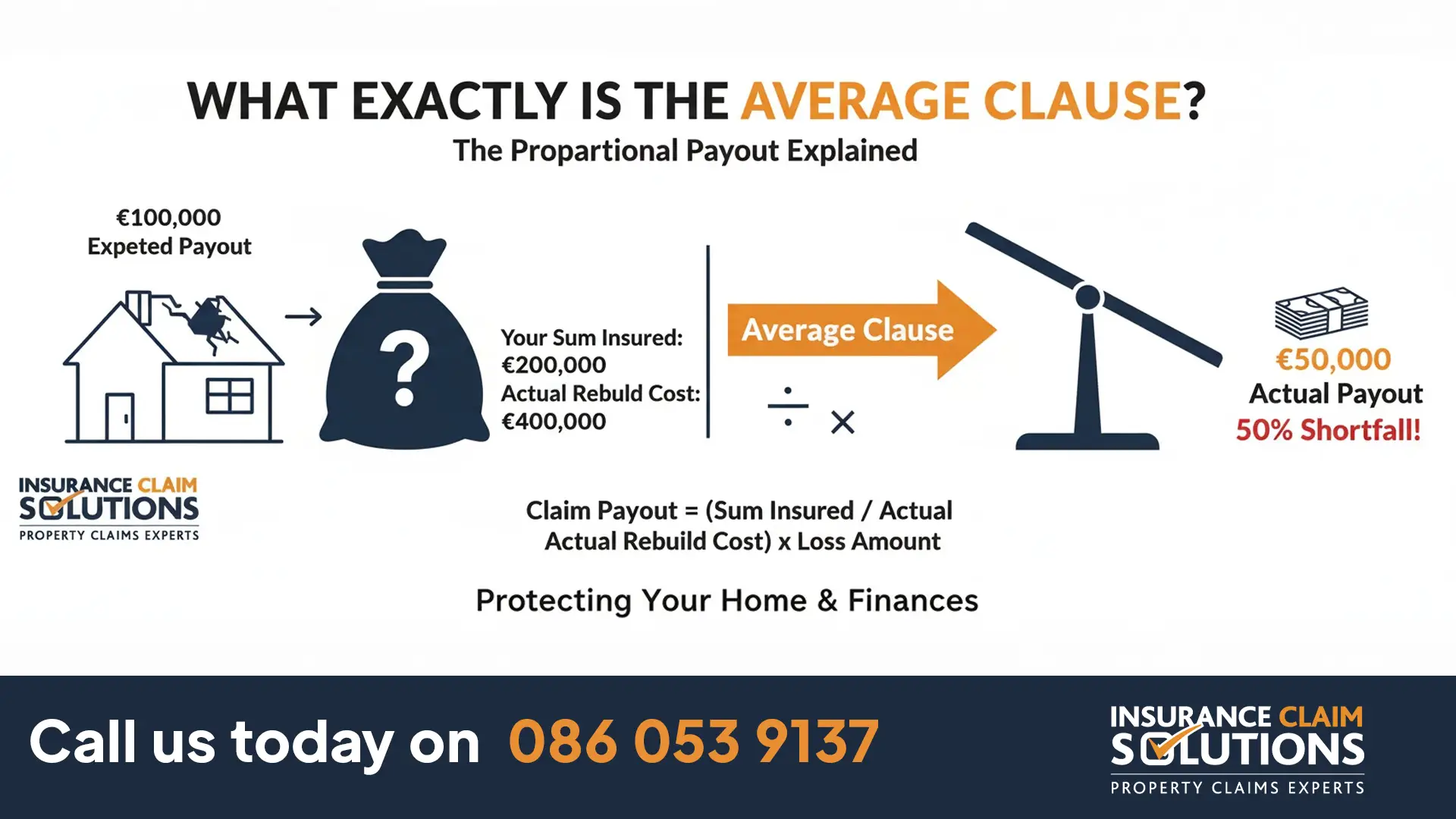
How Insurers Apply the Average Clause
Insurance companies don’t wait for total destruction to apply this clause. A burst pipe, causing €5,000 damage, can trigger it. So can a small kitchen fire. A claim of any size can be affected if your policy is subject to average.
The process works systematically. You make a claim, your insurer checks your sum insured against current rebuild costs, they find you’re underinsured, they reduce your payout proportionally, and you pay the difference yourself. If your policy is subject to average, this is how the payment is usually calculated. The terms are set out in your policy.

Legal Framework & Consumer Rights in Ireland
Irish insurers operate within the Central Bank’s Consumer Protection Code, which sets out how they must deal with customers.
Your policy documents set out whether the clause applies.
The Average Clause Formula: How Payouts Are Calculated
The Average Clause formula seems straightforward:
Let’s make this real.
That’s nearly 30% of repair costs from your pocket in the storm damage scenario. For being underinsured by an amount you probably didn’t know about.
On a larger claim the shortfall grows in proportion, and on a total loss it could leave you without enough to rebuild.
Why Irish Homeowners Fall Into the Underinsurance Trap
Property Values vs Rebuild Costs – The Confusion
Many people confuse market value with rebuild cost. It is an easy mistake, and an expensive one.
Market value includes land. Rebuild cost doesn’t. But rebuild cost includes demolition, site clearance, architect fees, VAT. Things market value ignores.
For illustration, a house in Dublin may sell for far more than it would cost to rebuild, because market value includes the land and the location.
Inflation’s Silent Erosion
Building costs have risen in recent years, so a sum insured that was adequate when you took out the policy may no longer be enough.
As an illustration, a sum insured that matched the rebuild cost some years ago may be below it today. Under the Average Clause, that gap is treated as underinsurance.
Home Improvements Nobody Tells Insurance About
New kitchen? Extension? Converted attic? Each increases rebuild costs.
Homeowners can spend a large sum on renovations and not update their insurance, and a claim can then fall short.
Every improvement needs a policy review, because improvements can increase the rebuild cost.
How the Average Clause Works: An Example
A home costs €320,000 to rebuild but is insured for €200,000, which is 62.5% of the rebuild cost. A flood causes €75,000 of damage.
Under the Average Clause, the insurer pays 62.5% of the loss: €46,875. The homeowner has to fund the remaining €28,125.
If the sum insured had matched the rebuild cost, the same loss would have been paid in full, subject to the policy excess and terms.
Tools & Resources to Avoid the Average Clause
Warning Signs You’re Already Underinsured
Check Your Sum Insured If Your Premium Seems Low: Premiums reflect many things, and a low sum insured can be one of them. Check your sum insured against your rebuild cost.
You Haven’t Updated Cover in Three Years: Building costs have risen in recent years. If your sum insured hasn’t, you may be underinsured. Even index-linking might not keep pace with recent inflation. Manual review is essential.
Using Original Purchase Price Plus Inflation: Property purchase prices and rebuild costs follow different trajectories.
Estate Agent Valuations as Basis: Estate agents estimate market value, not rebuild costs. This is a different expertise and yields different figures. Estate agent valuations and professional rebuild assessments of the same property can differ substantially.
Common Misconceptions That Cost Homeowners
Frequently Asked Questions about the Average Clause
Q: How often should I review my rebuild cost?
Annually at a minimum. After any improvements, do it immediately. When construction costs spike, don’t wait for renewal. Use any free rebuild cost reviews offered by your insurer.
Q: Can I challenge the Average Clause application?
If you disagree with how average has been applied, ask your insurer to explain the calculation. Independent evidence of the rebuild cost, such as a professional assessment, may be relevant, and you can complain to the insurer if you remain unhappy. It is far easier to make sure your cover is adequate before a claim than to dispute the calculation afterwards.
Q: Does the Average Clause apply to contents insurance too?
Yes, if your contents are underinsured, the same proportional reduction applies. Regularly value your possessions. A five-year-old TV isn’t worth its purchase price, but antique furniture might be worth more than you think.
Q: What if rebuilding standards have changed?
Modern building regulations often require upgrades during a rebuild (e.g., better insulation, accessibility, energy efficiency). These add costs and must be factored into your rebuild calculations. Your 1960s bungalow won’t be rebuilt to 1960s standards.
Q: Will my insurer warn me about underinsurance?
Your policy documents will tell you whether an Average Clause applies. It is up to you to make sure your sum insured is adequate, so review it at every renewal and after any improvements.
Q: Is the Average Clause legal?
Average clauses are a common term in Irish property insurance policies. Your policy documents will say whether your policy is subject to average.
Q: Do all insurers apply the Average Clause?
Many policies include an average clause and the terms differ between insurers. Some policies set a threshold below which it does not apply. Read your documents and ask your provider explicitly. Never assume.
Check Your Cover Now
The Average Clause isn’t going away, but you can reduce its effect on you by keeping your sum insured up to date.
Check your sum insured against the current cost of rebuilding your home.
Calculate your rebuild cost properly. Get a professional assessment if needed. Update your sum insured. Pay the extra premium.
Finding out you are underinsured after a fire or flood adds money worries to what is already a very hard time.
A few minutes with your policy schedule now can save a lot of trouble later.
Expert Guidance from Regulated Professionals
This guide is written by our team of loss assessors. Trevor Kelly Insurance Claim Solutions Limited, trading as Insurance Claim Solutions, is regulated by the Central Bank of Ireland (Reg. No. C423441). We act for homeowners, not insurers.
Trevor Kelly — Managing Director
Chartered Building Surveyor (MSCSI, MRICS) and public loss assessor
Led by Trevor, our team includes surveyors such as John Holland and claims staff, who act for policyholders from the first inspection through to settlement.
We Deal With Your Insurer On Your Behalf
Already facing claim issues? Worried about underinsurance? Our loss assessors can review your claim with you, deal with your insurer and its loss adjuster, and keep you up to date as the claim moves forward.
Free initial consultation. No win no fee.
Available 24/7, 365 days a year. Call us on: 01 870 9210
Disclaimer: This article provides general information about insurance claims and the Average Clause in Ireland. Individual circumstances vary. Always consult qualified professionals for advice specific to your situation.